
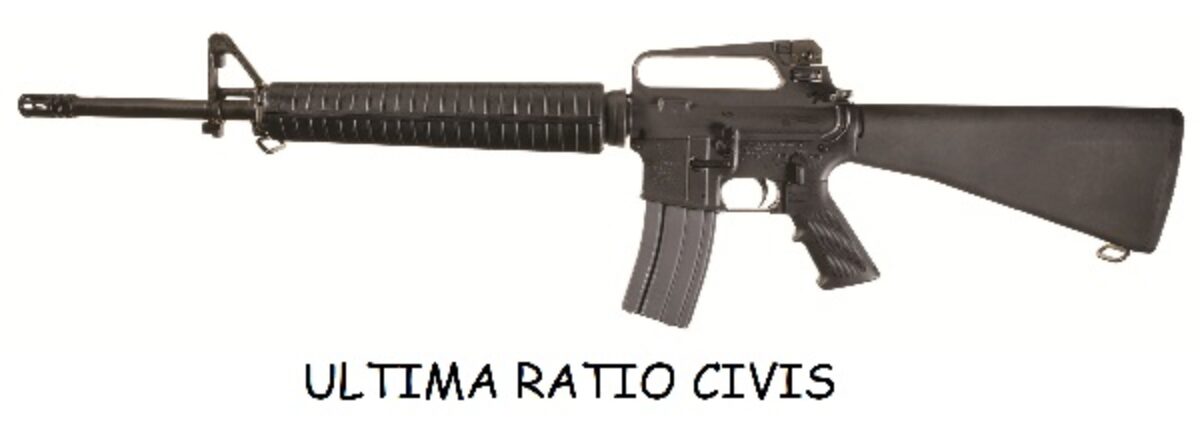

“The only effective solution against evil and violent people is good people more skilled in violence.”
— Miyamoto Musashi
October 27, 2026
Yes, Armed Civilians Can — and Do — Stop Mass Shootings
October 23, 2026 6:30 AM
Data ignored by the FBI show the importance of defensive gun use in bringing down active shooters.
Two days after last week’s attack on an Oregon elementary school, the Associated Press opened a news story with a familiar claim: “Few mass shootings in the U.S. end like the deadly attack on an Oregon elementary school: with an armed civilian opening fire on the gunman.” NPR also noted “how rarely an armed civilian ends an attack like this.”
Yet since January 2025, the Crime Prevention Research Center (CPRC) has documented 16 defensive gun uses in which police credited armed civilians with stopping what otherwise might have become mass public shootings, as in the attack in Oregon. During that same period, five mass public shootings occurred in the U.S. and Puerto Rico.
The AP bases its claim on data from the Advanced Law Enforcement Rapid Response Training (ALERRT) Center, which the FBI uses for its active-shooting reports. But the story ignores detailed challenges to those data that have appeared in such places as the Washington Post, Washington Times, and RealClearInvestigations.
The FBI defines an active shooter as someone actively killing or attempting to kill people in a populated, public area. An incident can qualify even if a gunman fires at just one person and misses. The category includes mass public shootings, but the FBI generally excludes shootings connected to other crimes, such as robberies or fights over drug turf.
I encountered problems with these data firsthand. Until January 2021, I served as senior adviser for research and statistics in the Justice Department’s Office of Justice Programs, where my responsibilities included evaluating the FBI’s active-shooter reports. I discovered that the reports omitted or misclassified numerous cases in which armed civilians stopped attacks.
The problem persists. From 2014 through 2025, the FBI identified 408 active-shooter incidents but credited armed citizens with stopping only 16 — just 3.9 percent.
The CPRC, however, has identified numerous additional cases and maintains an updated list. Our research tells a dramatically different story. We identified 615 active-shooter incidents from 2014 through 2025 and found that armed citizens stopped 225 of them. We excluded another 35 cases in which law-abiding armed citizens stopped attackers before they could fire a shot.

“The principle of self-defense, even involving weapons and bloodshed, has never been condemned, even by Gandhi.”
– Martin Luther King, Jr.
October 26, 2026


“Nature has made up her mind that what cannot defend itself shall not be defended.”
― Ralph Waldo Emerson
October 25, 2026
US switchblade law violates Second Amendment, appeals court says
A federal appeals court said in a ruling Wednesday that the U.S. restrictions on switchblades are unconstitutional.
Under the Federal Switchblade Act, it is illegal to sell, transport or manufacture the knives across state lines.
“We determine that switchblade knives qualify as ‘Arms’ and are covered by the ‘plain text’ of the Second Amendment,” U.S. Circuit Judge Jennifer Walker Elrod wrote in the ruling. “Because the regulation implicates the amendment, the government bears the burden of establishing that the FSA comports with well-established principles of the Second Amendment and its regulatory tradition. The government fails to meet its burden.”
Reuters reported that the three judges who made the ruling were appointed by Republican presidents.
Knife Rights, the organization that brought the suit against the Department of Justice, celebrated the ruling in a statement.
“This is a significant judicial recognition of what Knife Rights has argued for years,” Knife Rights said. “The Second Amendment protects knives, not just firearm
The Trace goes ‘toxic’ over lead rounds
It must be a difficult time to be an anti-gun activist working at the Trace—the propaganda arm of former New York City mayor Michael Bloomberg’s anti-gun empire. After all, things are certainly not going their way.
The National Firearms Act has been gutted. You can buy suppressors with ease, and America’s favorite rifle will likely become legal in all 50 states thanks to the U.S. Supreme Court. The changes are even more impressive at the lower levels. We’re seeing pro-gun triumphs almost every single week.
Finding any anti-gun story has got to be a daily concern for the kids at the Trace. They can’t report the facts because they’re not real reporters. So, instead of reporting that President Donald J. Trump—the most pro-gun President since Teddy Rooselvelt—is restoring our Second Amendment rights on a regular basis, what can the Trace possibly tell its readers?
Lead—specifically, lead is bad. In fact, it’s dangerous.
That’s the best the Trace kids could come up with.
According to a story in the Oct. 21st edition of The Bulletin, which the Trace publishes, “Six million children in the U.S. live in homes with people who use firearms with lead-based ammunition but don’t engage in post-shooting hygiene. That leaves the kids vulnerable to lead exposure.”
So, if you go shooting and don’t wash up, your kids are at risk, the Trace claims. Evidently, they know who’s washing up and who’s not.
This super-worrisome story was written by Fairriona Magee, who describes herself as the public health reporter for the Trace. She joined the Trace right after college. It’s her first paid gig. She also volunteers at a local food bank.
How does Magee prove her point that lead imperils every single shooter? She finds an expert, of course, who cites the “risk.”
“These findings just provide a suggestion that this is a bigger risk than I think people realize,” Christian Hoover, the study’s lead author and public health researcher at Harvard University, told me. “Hopefully, they’re willing to consider some of the suggestions that we make in the study, like changing your clothes after shooting, not bringing things into the home with you, and treating this activity when you’re using lead-based ammunition as though it were toxic.”
Unfortunately for her readers, Hoover, whom Magee described as a “public health researcher at Harvard University,” uses another title on his LinkedIn: Co-Investigator, Firearm Exposure Research Team at Harvard T.H. Chan School of Public Health.
I’m sure Harvard’s Firearm Exposure Research Team fully respects our Second Amendment rights, right?
Magee’s bulletin is short, thankfully. For anyone with even a modicum of firearm knowledge, it’s so bad it’s almost funny.
Magee never mentions that shooting outdoors lowers your risk of lead exposure dramatically, or that Americans have been shooting lead bullets downrange since before there was a United States of America.
Instead, she touted her company line — guns are super dangerous. If you own one, you’re at risk.
Magee wrote that she found the lead story while reading “gun violence” studies, which she does on a daily basis.
That type of shoddy research is also expected from the kids at the Trace.
DOJ Targets Two Connecticut Police Departments Over Alleged Gun Carry Permit Delays
The U.S. Department of Justice has launched federal civil rights investigations into two Connecticut police departments over allegations that they are improperly delaying or denying firearm carry permits, potentially leaving law-abiding residents unable to exercise their Second Amendment rights for years.
The investigations, announced on October 22, 2026, target the Waterbury and Middletown police departments. Federal officials will examine whether the municipalities are unlawfully obstructing residents seeking permits to carry firearms for self-defense.
The Justice Department’s Civil Rights Division, through its Second Amendment Section, is investigating whether local authorities are unreasonably denying otherwise qualified applicants and forcing them into a lengthy administrative appeals process before they can exercise a constitutionally protected right.
The central issue is whether government officials can effectively deny Americans their right to bear arms simply by delaying the paperwork required to exercise it.
“All law-abiding Americans have a constitutional right to bear arms for self-defense,” said Assistant Attorney General Harmeet K. Dhillon of the Justice Department’s Civil Rights Division. “This right is not a luxury reserved for a privileged few, but a fundamental liberty for all, including the residents of Middletown and Waterbury, Connecticut.”
Federal Investigators Examine Alleged Second Amendment Violations
On October 22, the Justice Department sent formal notification letters to Waterbury Mayor Paul Pernerewski Jr. and Police Chief Fernando Spagnolo Jr., as well as Middletown Mayor Gene Nocera and Police Chief Erik Costa.

War is when the government tells you who the bad guy is. Revolution is when you decide that for yourself.
– Benjamin Franklin.
October 24, 2026
The polls make a lot more sense when you realize Democrats’ only path to taking the Senate depends on Republicans staying home.
The goal is to demoralize you into sitting on the couch instead of showing up on Election Day.
Don’t fall for it.
If Republicans show up, we win.
It’s that simple.
— Dustin Grage (@GrageDustin) October 23, 2026
Armed Citizen Who Stopped Oregon School Shooting Speaks Out
Kaylub Giamanco, the man who shot and killed the 16-year-old engaged in a murderous rampage at Silver Rail Elementary School in Bend, Oregon, has shied away from the press in the wake of that horrific incident.
Giamanco has now broken his silence in an interview with Oregon Public Broadcasting, and in doing so has dispelled some of the myths created by the media about him. One “expert,” for instance, claimed that the “average” gun owner couldn’t have responded the way Giamanco did, declaring that his actions were the result of extensive training.
Giamanco, though, says that the gun he used to stop the attack had been “collecting dust” in his truck’s console.
When he saw the shooter throw the gun over the school fence before climbing it, “that’s when panic fled into my brain, and that’s when I opened my center console.”
His “heart dropped” for a second, he said, as he wondered if the .40 caliber handgun he rarely used would be there. It was. He got the magazine from a separate compartment and drove into the school parking lot while watching the shooter walk across the school grounds.“I just was in full panic, like, ‘No, there’s children, there’s babies in there.’ I told my Siri to call 911,” he said. The dispatcher had questions for him, but he didn’t stay on the call to answer them.
“I said, ‘I’m sorry, I have to go in. People are going to die.’”
So how much experience does Giamanco have with firearms? Honestly, it sounds like he really is a fairly typical gun owner. He tells OPB that his grandfather bought him his first gun (a shotgun) when he was seven, and he would go hunting with his grandfather and even helped him teach classes on gun safety, archery, and wilderness survival.
He stopped hunting when he was about 18, and didn’t pick up a firearm for years. Giamanco shared a Facebook post in 2018 that talked about shooting with a group of Iraq veterans, and he told OPB that he was introduced to the group when he was building a restaurant for an Iraq War veteran, who reintroduced him to shooting.
“He was highly decorated. He’s had multiple tours in Iraq and he is an amazing gentleman,” Giamanco said. “His platoon would come out to Bend and I built targets and walls for them.”
The veterans offered to train him on using military drill and weapons, and the experience inspired him to own guns again.
“I felt like if I didn’t have that training, I probably wouldn’t be alive today,” he told OPB.
That experience was clearly important to Giamanco and stuck with him, but he didn’t speak to OPB about how often he’s shot or trained in the years since. I think it’s fair to say that he’s knowledgeable and proficient with firearms, but nothing in the interview suggests that he’s been spending every weekend at the range since he got back into shooting eight years ago.
Giamanco says he plans on teaching his two daughters how to shoot safely and responsibly, telling OPB that “It’s more dangerous to be afraid of a gun than it is to just be comfortable with one and know that they’re there to either provide you food or to provide you protection.”
He also wants to use his position to help make schools safer.
An idea has taken hold in the days since the Silver Rail shooting: a motocross race that donates all proceeds to schools for improving their safety. That could mean funding bulletproof glass on the doors, better locks, and better research to make these kids feel safe at school. He also wants school resource officers at every school.
“We have AI. We are in a world of technology right now. We have smart homes. We have smart cars. Why can’t we have smart schools?”
The shooting at Silver Rail Elementary was traumatic for everyone, including Giamanco, who struggles with not being able to save everyone in the classroom targeted by the killer. He told OPB that he wanted to “apologize for not saving their babies,” and called the unarmed teacher who fought the attacker before he stepped into the classroom a “real true hero.”
Giamanco’s entire interview is worth reading, and I appreciate him sharing his story.
I also hope he comes to realize that he has nothing to apologize for. He didn’t the deadly circumstances for those children and teachers. He simply refused to stand by when he realized what was happening, even though he had no way of knowing whether he’d survive his attempt to stop the killer.
Kaylub Giamanco couldn’t save everyone. But because he was there, because he was armed, and because he was willing to act, there are children alive today who otherwise might not be.